Foreign talent feeling gypped by top agency

Inagawa Motoko Office, one of the largest and oldest show business agencies catering to foreign performers in Japan, recently came under fire from some of its registered artists for not paying them in a timely manner for work they have done.

In recent interviews with The Japan Times, 10 people registered with IMO said those who do not ask the agency for money multiple times have no chance of getting paid, and there are many foreigners who have gone home unpaid.

All of the 10, five of whom asked not to be named because they don’t want to upset the agency, said they are registered with several other agencies but have no similar problems with them.

IMO is not violating any written contracts because the people it uses do not sign one that stipulates the timing of payment before each job, which range from ¥10,000 to ¥50,000 for a few hours of work or a full day.

Industry experts say there may be other agencies with similar delinquent payment practices, because many agencies are not well known. But the normal practice is to tell artists what they will earn in advance and to pay wages on time.

Louis Carlet of Zenkoku Ippan Tokyo General Union recommended that foreign artists unionize.

“If they unionize, they have collective bargaining power. They will have more strength,” he said, adding that even one person can join his union.

http://search.japantimes.co.jp/cgi-bin/nn20100629f2.html

Opening Japan’s Immigration Door

Buried in the government’s new growth strategy is a short section calling for an easing — albeit slight — in Japan’s ultra-tight immigration restrictions. It’s a small gesture, but symbolically significant for a nation that has been slow to open its borders, despite a shrinking native population.

The Kan administration hopes to “double the number of highly skilled foreign personnel” over the next decade, said the report issued Friday. That’s up from about 200,000 now.

An accompanying Justice Ministry report suggests specific policy changes to reach that goal, such as allowing those people to stay in Japan on special visas for five years — up from the current three — and to make it easier for them gain permanent residency status.

The goal, according to the Justice report is to “show the world what sort of highly skilled talent the country hopes to strategically invite.” Such an influx, it added, could: “increase productivity of industry, stimulate the labor market, and consequently, create new energy in the social economy and strengthen international competitiveness.”

Japan is one of the least immigrant-friendly developed countries in the world. In 2006, just 1.1% of Japan’s workforce (about 753,000) was made up of immigrants, highly skilled or otherwise, compared with 8.5% for Germany and 15.6% for the U.S.

http://blogs.wsj.com/japanrealtime/2010/06/23/opening-japans-immigration-door/

Workplace bans on beards raise hairy questions

In May, the city of Isesaki, Gunma Prefecture, banned all male municipal employees from sporting beards in the office on the grounds that public servants should look decent. The city took the action after some residents complained about its bearded workers.

In response to the news, the Internal Affairs and Communications Ministry said it had never heard of any municipality introducing such a rule.

Seven-Eleven Japan Co. is particularly strict about the appearance of its employees and says it won’t hire men with beards.

“We might fire workers growing beards regardless of whether they are regular staff or part-time workers,” a public relations official said.

Oriental Land Co., owner of the Tokyo Disney Resort, also bans beards, like its U.S. counterpart.

“It’s important that workers serving our guests maintain an immaculate image,” an official said. “But the rule doesn’t apply to the man playing the role of Captain Hook in our park.”

The manufacturing arm of razor maker Kai Corp. tests the quality of its products almost every month on its male workers. They grow facial hair until the monthly test date arrives and get back to work cleanshaven after the tests.

Some men take issue with the bans.

An employee of Japan Post Service Co. sued the firm to protest a pay cut imposed because of his beard.

In March, the Kobe District Court ordered the company to pay him ¥370,000 on grounds that a person’s appearance is a matter of personal freedom and a uniform ban on beards is unreasonable.

No regulations exist regarding facial hair in the world of sumo, the most tradition-bound of sports in Japan.

According to the Japan Sumo Association, some non-Japanese wrestlers have taken flak in the past because they tend to be more hairy than most Japanese and some fans found their bushy facial hair unseemly. By and large, not wearing a beard is a tacit rule.

The association, however, is rather flexible regarding the issue.

“We work in the world where luck counts a great deal, so some wrestlers don’t shave during a winning streak” because they fear it would change their luck, an association official said.

http://search.japantimes.co.jp/cgi-bin/nn20100622f1.html
Tozen ALTs Sue For Unpaid Wages

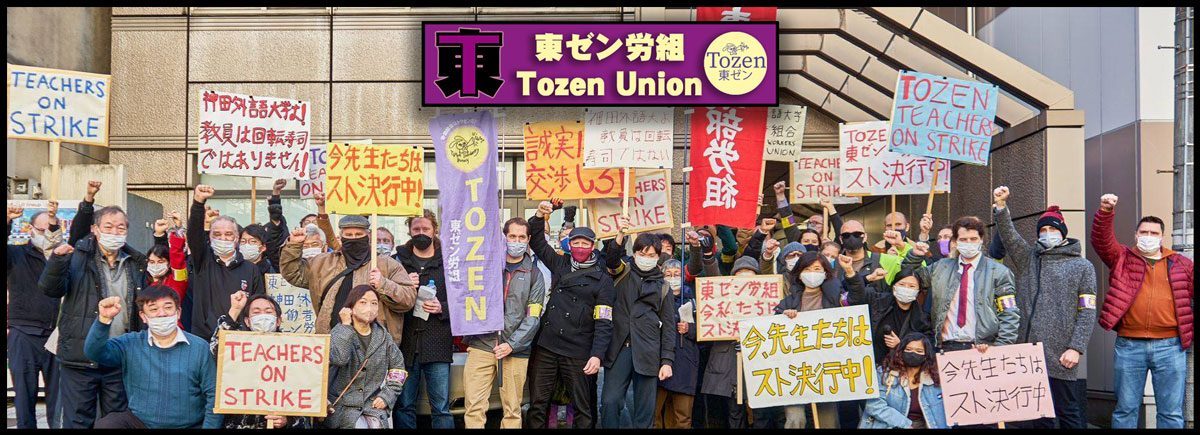
Yesterday, seven Zenkoku Ippan Tokyo General Union ALT branch members sued Japan Advanced Labor Agency head (and JALSS Representative Director) Muhammed Ali Muhammed Mustafa (AKA Max Ali) at Tokyo District Court for a combined amount of 1,943,760 yen in unpaid wages and transportation expenses contractually owed the members while they worked for Muhammed Ali Muhammed Mustafa at the Funabashi City and Saitama City Boards of Education. Union lawyer Ken Yoshida asks the court for a provisional injunction and includes a claim for interest also to be paid at a rate of 6% yearly on top the unpaid wages.

This lawsuit is in addition to the breach of contract suit already in progress at Tokyo District Court with Muhammed Ali Muhammed Mustafa with a claim approaching 3,000,000 yen from another Zenkoku Ippan Tokyo General Union Tozen ALT member. The member previously won a favorable judgement for this claim against Mr. Mustafa at the Rodo Shimpan Labor Tribunal.

Are you an Assistant Language Teacher?

Are you unable to make ends meet because of unpaid wages, unpaid transportation expenses and dubiously documented pay deductions?

Join Zenkoku Ippan Tokyo General Union Tozen ALTs and help us build a union at your company and BOE.

95% fear for Japan’s future

According to an Asahi Shimbun survey, about 95 percent of Japanese are worried about Japan’s future, while 62 percent say the nation is being rapidly overtaken by other countries.

Asked about their future vision for Japan, 51 percent said they hope to see a society that promotes economic wealth through hard work, while 43 percent said Japanese society should be one that achieves a relatively comfortable level of wealth without working too hard.

Seventy-three percent said they preferred a nation that is “not so affluent but has a smaller income disparity,” against 17 percent who chose “an affluent society but with a large disparity.”

Fifty-eight percent favored a large government offering full administrative services, such as social security, even at the cost of higher taxes, while 32 percent preferred a small government.

As for Japan’s role in the world, 39 percent said Japan should be a major player with more clout and obligations, while 55 percent said they did not think Japan should be a global power.

On accepting immigrants to maintain economic vitality, only 26 percent supported such a move, while 65 percent opposed.

http://www.asahi.com/english/TKY201006110455.html

RCS ALTs Declared to Management

Today, RCS members of the Tozen ALT Branch historically declared their union membership to RCS management and submitted a list of nine demands along with a call to the company to begin collective bargaining talks with Zenkoku Ippan Tokyo General Union on June 30, 2010 [rescheduled for July 16th, 2010 at company request].

The demands include:

Working Condition Demands 規範的部分 Kihanteki Bubun

1. Company eliminate temporary employment status for all members and recognize open-ended employment with no degradation to working conditions in order to give members job security.
会社は、全組合員の安定した雇用を実現するため、従来の労働条件を悪化することなく、有期雇用の雇用形態に拘らず期間の定めのない雇用を認める。

2. Company eliminate piecemeal wages and institute monthly guarantees for all union members with no degradation to working conditions.
会社は、全組合員の給料に対し、従来の労働条件を悪化することなく、出来高制を廃止し、月額保障の制度を認めること。

3. Company enroll all union members in unemployment insurance on the assumption of continued employment.
会社は、継続雇用を前提に全組合員を雇用保険を加入させること。

4. Company pay the actual transportation costs for the commute to and from work to all union members.
会社は、全組合員に対し、通勤に伴う交通費の実費を支払うこと。

Are you an ALT working for RCS?

Do you want to improve the working conditions of yourself and other teachers? Take the first step towards improving your quality of life by joining the Tokyo General Union today!

柏のALT偽装請負:英語授業7月再開 役割分担明確化 /千葉

柏市立の小中学校全61校で英語を教えていた外国人指導助手(ALT)について厚生労働省千葉労働局が違法な「偽装請負」と認定した問題で、是正を指導された柏市教委は28日、英語の授業を7月初旬に再開すると発表した。従来通りの業務委託契約だが、授業で外国人講師と日本人教師の受け持ち時間を区切り、教師からの指示命令をなくすことで違法状態とならないようにするという。

Read more

Groups push for better refugee treatment

Organizations supporting people seeking asylum in Japan urged the government Monday to improve the treatment of refugees at immigration control centers, two of which have seen hunger strikes by detainees this year.

The groups, including Amnesty International Japan, say the Justice Ministry’s policies, including mandatory detention of asylum seekers and long periods of detention without clear deadlines, are major problems that need to be fixed immediately.

The immigration authorities should also provide a better living environment as well as medical treatment for asylum seekers, whose stress levels increase the longer they are in detention, they said.

“These issues need to be solved, not just for the benefit of my clients. The situation is also an embarrassment for Japan,” lawyer Takeshi Ohashi said at the Foreign Correspondents’ Club of Japan.

Ohashi has represented numerous people seeking political refuge in Japan.

Although a council affiliated with the government will inspect immigration detention facilities starting in July, Ohashi stressed that an environment where nongovernmental organizations can work closely with them should be secured so the council can function as an effective third-party surveillance authority.

According to Hiroka Shoji of Amnesty International Japan, two detainees committed suicide, in February and April, at the East Japan Immigration Control Center in Ushiku, Ibaraki Prefecture. In March and May, outbreaks of tuberculosis were confirmed there and at a facility under the jurisdiction of the Tokyo Regional Immigration Bureau, she said.

http://search.japantimes.co.jp/cgi-bin/nn20100601a6.html

授業時間を外国人と分離 柏市の指導助手事業再開へ

柏市立小中学校の外国語指導助手(ALT)事業が千葉労働局から是正指導を受け、中断している問題で、市教育委員会は28日、日本人の教員と外国人で担当の授業時間を分ける方法を導入し、7月から業務委託方式で事業を再開すると明らかにした。

Read more