A level playing field for immigrants

Despite Japan’s looming demographic disaster — you know, the aging society and population drop due to low birthrates and record-long life spans — we still have no immigration policy. No wonder: The people charged with dealing with non-Japanese (NJ) — i.e. the Ministry of Justice’s Immigration Bureau and sundry business-sector organizations — just police NJ while leeching off their labor. Essentially, their goal is to protect Japan from the outside world: keep refugees out, relegate migrant workers to revolving-door contracted labor conditions, and leash NJ to one- to three-year visas. For NJ who do want to settle, the Justice Ministry’s petty and arbitrary rules can make permanent residency (PR) and naturalization procedures borderline masochistic.

This cannot continue, because Japan is at a competitive disadvantage in the global labor market. Any immigrant with ambitions to progress beyond Japan’s glass ceiling (that of either factory cog or perpetual corporate flunky) is going to stay away. Why bother learning Japanese when there are other societies that use, say, English, that moreover offer better lifetime opportunities? It’s time we lost our facile arrogance, and stopped assuming that the offer of a subordinate and tenuous life in a peaceful, rich and orderly society is attractive enough to make bright people stay. We also have to be welcoming and help migrants to settle.

As in any society, police are here to maintain law and order. The problem is that our National Police Agency (NPA) has an explicit policy mandate to see internationalization itself as a threat to public order. As discussed here previously, NPA policy rhetoric talks about protecting “citizens” (kokumin) from crimes caused by outsiders (even though statistics show that insiders, both in terms of numbers and percentages, commit a disproportionate amount of crime). This perpetual public “othering and criminalizing” of the alien must stop, because police trained to see Japan as a fortress to defend will only further alienate NJ.

In other words, the 2000s saw the public image of NJ shift from “misunderstood outsider” to “social destabilizer”; government surveys even showed that an increasing majority of Japanese think NJ deserve fewer human rights!

Let’s change course. If Hatoyama is as serious as he says he is about putting legislation back in the hands of elected officials, it’s high time to countermand the elite bureaucratic xenophobes that pass for policymakers in Japan. Grant some concessions to noncitizens to make immigration to Japan more attractive.

Otherwise, potential immigrants will just go someplace else. Japan, which will soon drop to third place in the ranking of world economies, will be all the poorer for it.

http://search.japantimes.co.jp/cgi-bin/fl20091201ad.html

FOREIGNER SUFFRAGE

Local vote for foreign residents: time ripe?

Permanent foreign residents of Japan may finally face a realistic chance of being granted local-level suffrage under the administration led by the Democratic Party of Japan, which has signaled a willingness to pursue such rights.

Foreign nationals at present can’t vote in national or local-level polls, and changing the law has been a bone of contention over the years, particularly under the administrations of the long-ruling Liberal Democratic Party, whose conservative ranks lined up against granting suffrage by arguing that permanent foreign residents must first become naturalized citizens.

But DPJ heavyweights Prime Minister Yukio Hatoyama, Foreign Minister Katsuya Okada and Secretary General Ichiro Ozawa are all advocates of giving foreigners the vote at the local level, and after knocking the LDP out of power last August the DPJ is now in a position to craft legislation it has been pushing since 1998, when the party was launched.

Special permanent residents, who include Korean and Taiwanese who lived in Japan before and during the war and were forced to take Japanese nationality, and their descendants; and general permanent residents, who are relative newcomers from China, Brazil, the Philippines and other areas who have received the appropriate visa status.

At the end of 2008, some 912,400 foreign nationals were registered with the government as permanent residents. Among them, 420,300 were special permanent residents, according to the Justice Ministry’s Immigration Bureau.

Permanent residency is generally granted to people with stable jobs who have lived in Japan at least 10 years. People who are married to a Japanese national are only required to have lived in the country for five years to be eligible.

Local-level suffrage was originally a desire primarily among special permanent residents who lived and worked in Japan for generations, but general permanent residents now outnumber them and also want the vote.

Advocates point out that permanent foreign residents are treated in virtually all other regards as taxpaying Japanese and thus should have the right to vote on matters pertaining to their immediate communities.

The general public also appears to be in favor of granting such rights. According to a recent survey by the Mainichi Shimbun covering 1,066 people, 59 percent supported granting local-level suffrage to permanent foreign residents, while 31 percent did not.

Globally, at least 38 countries — including many EU nations, the United States and South Korea, to name a few — currently allow local-level voting rights for resident foreigners.

The DPJ pledged during the campaign for the August election to keep pushing for laws to grant local voting rights to permanent foreign residents, but the party’s higher priority manifesto avoided the issue.

DPJ Diet affairs chief Kenji Yamaoka recently hinted that a lawmaker-sponsored bill might be drafted during the current extraordinary Diet session. Although the plan was aborted due to expected resistance from within the DPJ and from coalition partner Kokumin Shinto (New People’s Party), a bill is expected to be submitted at the earliest during next year’s regular Diet session.

Behind the push is speculation that Ozawa — who has a strong say in Diet proceedings — is eyeing next summer’s Upper House election as well as nationwide local-level elections in 2011, and sees such a bill as an opportunity to drive a wedge between the LDP and New Komeito, which is clearly supportive of granting voting rights to foreign residents.

Should a bill eventually get passed, it will undoubtedly be embraced by the foreign resident community.

The Korean Residents Union in Japan (Mindan), the largest organization of permanent South Korean residents in Japan, campaigned for candidates supportive of foreigners’ suffrage during the recent general election. Many of the candidates were elected as DPJ lawmakers.

While Hatoyama and Ozawa are both strong advocates of foreigner suffrage, they still face opposition within their party.

But considering how Hatoyama and Ozawa have both promised the South Korean government and Korean organizations here to move forward with the issue, it seems likely the DPJ will seriously consider following through on its pledge in the near future.

http://search.japantimes.co.jp/cgi-bin/nn20091201i1.html

Agency for foreigners called for

Representatives from municipalities with a large number of foreign residents are calling for the central government to set up a new agency aimed at improving their livelihoods.

The proposal made Thursday by a group of 28 municipalities in seven prefectures said they have recognized the need for the government to create such an entity so that foreigners in Japan will be better off at a time of economic difficulties.

They also proposed that foreigners have the same rights and responsibilities as Japanese nationals and make it mandatory for children with foreign nationality to attend schools in Japan.

The proposal was handed to Democratic Party of Japan Vice Secretary General Goshi Hosono.

http://search.japantimes.co.jp/cgi-bin/nn20091128b2.html

Number of temporary workers in Japan up 4.6% in fiscal 2008

Japan saw the number of temporary workers rise by 4.6 percent in fiscal 2008, a survey released by the Ministry of Health Labor and Welfare showed on Thursday.

The number of workers now on temporary contracts stood at 3.99 million for fiscal 2008, in a country that was once known for companies that gave their staff jobs for life.

The survey compiled numbers from 66,424 businesses that declared their employment records to the government in the fiscal year that ended on March 31. In recent years, Japan has seen the number of temporary workers on its books increase, as the baby boomer generation begins to retire, and company workers are replaced by people hired from outside agencies.

In fiscal 2007, the nation saw the number of temporary workers increase by 18.7 percent.

Temporary workers are afforded less rights under the Japanese labor law, and can often be dismissed with very short notice and little compensation.

In the aftermath of the credit crisis that started in the United States last year, many temporary workers were left jobless with little money last winter.

The figures for 2008 showed that 2.81 million people were employed on short-term contracts with companies. The 1.18 million workers were in dispatched to companies on long-term contracts.

The governing Democratic Party of Japan said in its election manifesto this summer that it aims to improve the nation’s employment conditions, and “ban, in principle, the dispatch of temporary workers to manufacturing jobs.” The figures released Thursday showed that the number of temporary workers in manufacturing jobs had risen by 19.6 percent from the previous year to 560,000 people on June 1, 2008.

Critics of the temporary worker system have argued that the insecure nature of the jobs provides a great deal of benefits for large companies, but is on the whole detrimental to society.

In the last year, Japan has struggled to bounce back after suffering a downturn in the aftermath of the credit crisis, with weak employment and bad conditions for households preventing growth in the manufacturing sector from turning into a sustained recovery.

http://news.xinhuanet.com/english/2009-11/26/content_12542627.htm

Attention ALTs!

If Interac tries to pressure you into signing up for Kokumin Kenko Hoken, don’t do it! Kokumin Kenko Hoken is for people that are self-employed or unemployed. If you sign up for Kokumin Kenko Hoken, you may be forced to back enroll into the system up to the time that you started working in Japan (meaning you will have to pay your monthly dues up to the maximum limit of two years).

Instead, you should enroll into Shakai Hoken, because Interac will be forced to pay their half. If there is any back enrollment it will be covered by the company, not by you. You are all eligible for this. The only reason Interac tells you otherwise is because they don’t want to pay their portion of the money.

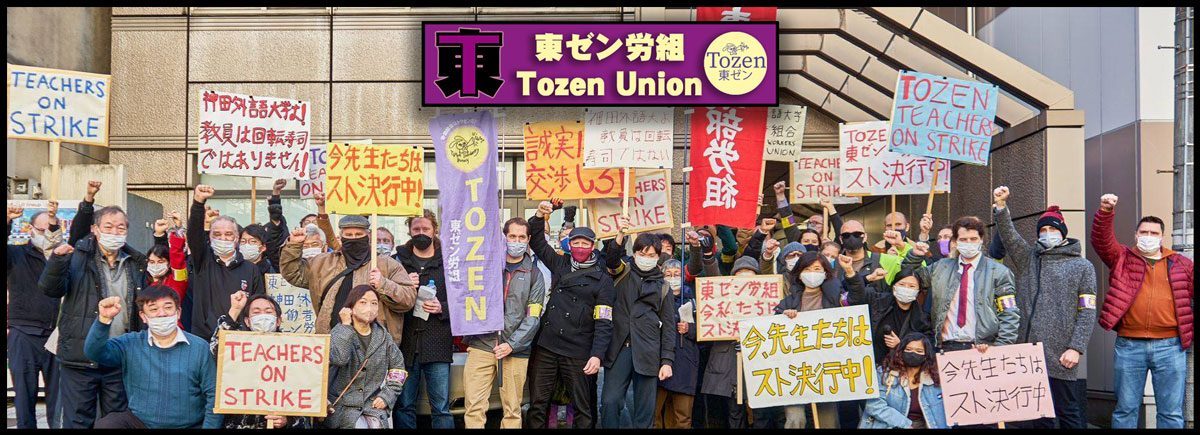
You can do this on your own, or you can join the “Interac union” (aka members of the Zenkoku Ippan Tokyo General Union Tozen ALTs) and we can force them to pay up together in solidarity. The Tokyo General Union has a lot of experience in forcing companies to enroll their employees into Shakai Hoken so we can get you enrolled with much less effort on you part.

Solidarity

Foreigner vote not reciprocal

The Democratic Party of Japan is likely to give local election voting rights to foreigners with permanent residence status and who are from countries or regions with diplomatic links or other ties to Japan, sources said Monday.

They include South Korea, which has diplomatic ties, and Taiwan, which lacks diplomatic links but has a strong working relationship with Japan, they said. The ruling party may submit the relevant bill in the current extraordinary Diet session, they said.

The bill will not take the so-called reciprocal approach of granting voting rights to long-term foreign residents on the basis of whether their countries confer similar privileges on Japanese citizens, they said.

http://www.asahi.com/english/Herald-asahi/TKY200911110133.html

Bill eyed to give vote to foreigners

The Diet affairs chief of the ruling Democratic Party of Japan said Friday that DPJ lawmakers were planning to introduce a bill to grant foreign nationals with permanent resident status the right to vote in local elections.

Kenji Yamaoka also said the current extraordinary Diet session may have to be extended beyond its scheduled end on Nov. 30 because of the need to deliberate on this and 12 other bills.

DPJ Secretary-General Ichiro Ozawa has pushed for giving voting rights to permanent residents of Japan, many of whom are Koreans.

The opposition New Komeito is also in favor of the move.

http://www.asahi.com/english/Herald-asahi/TKY200911070139.html

DPJ exec eyes suffrage bill this term

The Democratic Party of Japan may submit a bill during the current extraordinary Diet session that would grant permanent foreign residents the right to vote in local-level elections, DPJ Diet affairs chief Kenji Yamaoka told reporters Friday, noting the session may also have to be extended.

His comments come a day after Prime Minister Yukio Hatoyama indicated submitting such a bill anytime soon would be difficult, indicating next year would be the earliest proposed legislation would appear.

Speaking after attending a meeting with Liberal Democratic Party Diet affairs chief Jiro Kawasaki, Yamaoka said he told his opposition counterpart the bill may be submitted as lawmaker-sponsored legislation and asked for cooperation from the conservative LDP, which has been against foreigner suffrage.

“Considering the various opinions that exist within (the DPJ), depending on the circumstances we could ask lawmakers to vote on an individual basis,” Yamaoka said.

Yamaoka also said the Diet session may have to be extended from its current Nov. 30 deadline to allow enough time to deliberate various legislation and treaties.

Hatoyama has been playing down the prospects for drafting the foreigner suffrage bill, saying a consensus has not been reached within the ruling coalition, let alone the general public, over the issue.

http://search.japantimes.co.jp/cgi-bin/nn20091107a4.html

An open letter to Interac concerning health insurance

An open letter to the management of Interac (as well as Maxceed and Selnate)

November 5th, 2009

To whom it may concern (including Kevin Salthouse and Denis Cusack),

I am an executive of the ALT branch of Tokyo Nambu’s Foreign Workers Caucus. I worked for Interac  from September of 2005 until February 2008, under the Osaka branch.

I am writing to clear up some misconceptions about health insurance in Japan that were evident in a couple of PDFs that were circulated from management at the beginning of October 2009.

The two PDFs in question are the “FAQ – Insurance System in Japan” and the one titled “Social Insurance Letter” dated October 1st, 2009. In these PDFs, you tell your ALTs that they are not eligible for Shakai Hoken if they work less than 29.5 hours.

This is not true.

You also tell them that the only alternative is to sign up for Kokumin Kenko Hoken and that they may have to pay up to two years of back enrollment.

The problem is that, since they are eligible for Shakai Hoken, it is the company that will have to pay the back enrollment (up to two years) into Shakai Hoken, after which the employee can be billed for their half of enrollment fees.

Let me give you some background information on how I know this.

Read more