Attracting more foreign tourists can help offset the loss of economic vitality foreseen as the nation ages and the population declines, tourism minister Sadakazu Tanigaki said Monday.
“Even if we work hard to expand internal demand while the population declines, it won’t be enough,” Tanigaki said in an interview with The Japan Times. “It will be necessary to bring in people, commodities and money from developing areas.”
To this end, the Japan Tourism Agency will be established under the Land, Infrastructure, Transport and Tourism Ministry in October.
Welcoming more Asian tourists is a way to revitalize the economy, the former finance minister said.
Tanigaki said Japan has huge growth potential in tourism. “Our country has such a (long) history and abundant nature with four seasons,” Tanigaki said. “There is still room for further growth” in the number of foreign visitors, he stressed.
Month: August 2008
Once a ‘gaijin,’ always a ‘gaijin’
Gaijin. It seems we hear the word every day. For some, it’s merely harmless shorthand for “gaikokujin” (foreigner). Even Wikipedia (that online wall for intellectual graffiti artists) had a section on “political correctness” that claimed illiterate and oversensitive Westerners had misunderstood the Japanese word.
I take a different view: Gaijin is not merely a word; it is an epithet ? about the billions of people who are not Japanese. It makes assumptions about them that go beyond nationality.
Let’s deal with the basic counterarguments: Calling gaijin a mere contraction of gaikokujin is not historically accurate. According to ancient texts and prewar dictionaries, gaijin (or “guwaijin” in the contemporary rendering) once referred to Japanese people too. Anyone not from your village, in-group etc., was one. It was a way of showing you don’t belong here ? even (according to my 1978 Kojien, Japan’s premier dictionary) “regarded as an enemy” (“tekishi”). Back then there were other (even more unsavory) words for foreigners anyway, so gaijin has a separate etymology from words specifically meaning “extra-national.”
Even if one argues that modern usage renders the two terms indistinguishable, gaijin is still a loaded word, easily abused.
For gaijin is essentially “n–ger” and should be likewise obsolesced.
Fortunately our media is helping out, long since adding gaijin to the list of “hoso kinshi yogo” (words unfit for broadcast).
So can we. Apply Japan’s slogan against undesirable social actions: “Shinai, sasenai” (“I won’t use it, I won’t let it be used.”).
More children born with a foreign parent
Japan needs to deal with legal ramifications, experts say
One of every 30 babies born in Japan in 2006 had at least one parent originating from overseas, according to a recent government survey.
The survey by the Health, Labor and Welfare Ministry found that the mother, father or both parents of 35,651 babies born here originated from countries other than Japan. This represents about 3.2 percent of the 1.1 million babies born nationwide in 2006.
The survey indicates that an increasing number of foreign nationals coming to Japan for employment or study are settling in the country, experts said.
While the increase in children with at least one non-Japanese parent will broaden the range of cultural background among the country’s residents, a lot more needs to be done to accept and provide legal protection for people from different backgrounds, they said.
The trend reflects the increasing number of foreigners marrying Japanese nationals. Of newly registered marriages in 2006, 6.6 percent involved at least one foreign national.
Of the year’s 49,000 marriages of mixed couples, about 36,000 involved a Japanese husband and non-Japanese wife.
Of the babies with at least one non-Japanese parent, 5.7 percent were born in Tokyo, followed by 4.9 percent in Aichi Prefecture and 4.5 percent in Mie Prefecture.
Kids’ language woes
A record 25,411 foreign students needed assistance with the Japanese language in everyday life or in the classroom as of last September, up 13.4 percent from a year earlier, according to a study on public schools by the education ministry.
It was the fifth consecutive annual increase. The number of such students has increased 46.9 percent since 1997 as more foreign workers have settled here and started to have school-age children.
Of the total, 21,206, or 83.5 percent, said they were receiving Japanese-language education, down 2.1 percentage points.
A panel of experts proposed in June that the education ministry step up training of Japanese-language instructors in light of the growing need.
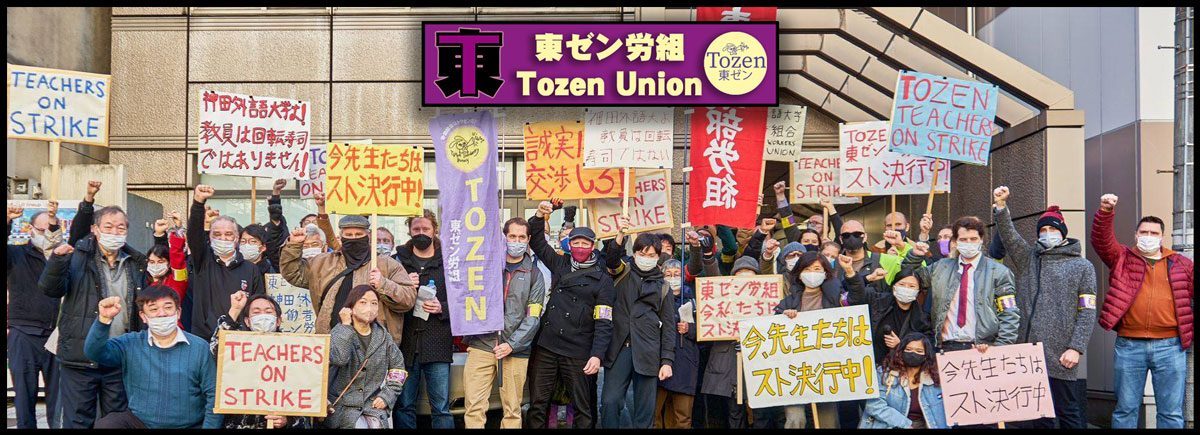
Goodwill ceases operations; union stages protest
Scandal-ridden temp staff agency Goodwill Inc. closed its doors for good Thursday, leaving at least 900 registered workers unable to find new jobs and a union grumbling about unpaid wages and other problems.
According to Goodwill officials, about 1,600 temp workers out of the approximately 6,000 registered with the agency in late June have been directly employed by the companies where they had been dispatched.
The demonstrators chanted slogans such as “take responsibility for disposable employment practices.” Others complained of unpaid overtime allowance.
“They created so many problems, and as a result have dissolved the company. It is despicable that they are not even taking proper measures to clean up afterward,” said a 48-year-old Tokyo man who had been working as a day-contract temp worker for five years.
Although he has been hired by the company to which he was dispatched, he said he has yet to collect about 500,000 yen in pay for overtime work over a two-year period.
Goodwill, once an iconic figure in the world of day-contract temporary work, has been accused of violating the employment security law and temp worker dispatch law. Goodwill engaged in a practice known as “double dispatching,” in which workers are sent to one company but forwarded to other companies. The practice is prohibited because it makes unclear who is responsible for the workers’ safety.
Goodwill also failed to properly write the names of workers on contact papers.
http://www.asahi.com/english/Herald-asahi/TKY200808020061.html