Where did all the babies go?

Last Wednesday, the Ministry of Health, Labor and Welfare announced that Japan’s total fertility rate (TFR) ? the average number of babies born to women during their reproductive years ? rose slightly to 1.34 for 2007, even though about 3,000 fewer children were born last year than in 2006. Two years ago the TFR was at 1.26, a postwar low, and last year this country experienced a natural population decline for the first time since 1899, when data-gathering in this area began. If fertility remains constant at these levels ? and projections for the next 50 years have it doing just that ? the population of each successive generation will fall at a rate of approximately 40 percent.

To address this concern, administrations have implemented a number of programs over the past two decades. In fact, the cost per month incurred by the government to fund day-care services in Tokyo for one infant currently exceeds the average monthly wage of a male worker in the capital.

But have you ever wondered how the fertility rate ended up dropping so low in the first place? Well, follow along with me to gain a better understanding of not only that, but also why one of the actions government has since taken appears to be biased against non-Japanese ? the very people who may be needed to reverse this trend and provide support for Japan’s rapidly aging society.

About half of employed married women work part-time, and about three-quarters of part-time workers are women. A large number of non-Japanese are also employed on fixed terms. Japan’s English-teaching industry, in effect, has been built on the backs of such labor. In fact, Louis Carlet, deputy general secretary of the National Union of General Workers Tokyo Nambu, estimates that 90 percent of non-Japanese in this country are employed as nonregular employees.

Fortunately, a revision to the Child-Care and Family-Care Leave Law was put in effect from April 2005, and this revision guarantees nonregular employees utilization of child-care leave under two conditions: First, the person must have been employed by his or her employer for a continuous period of at least one year; and second, the person must be “likely to be kept employed after the day on which his or her dependent child reaches one year of age,” according to the translation provided by the Cabinet Secretariat.

“Likely to be kept employed?” For those who may have trouble reading between the lines, this provision affords the employee absolutely no protection at all. Basically, this “law” is telling the employer: If you really want to allow your nonregular employee to take child-care leave, sure, go ahead; but hey, if you really don’t, no worries ? this “law” is not going to prohibit you from terminating his or her employment. For a country that needs a significant increase in its TFR, government would be wise to close this loophole.

http://search.japantimes.co.jp/cgi-bin/fl20080610zg.html

Nova ‘paid bills with employee welfare fund’

About 300 million yen contributed by employees of the bankrupt language school chain Nova Corp. to a staff welfare fund was transferred to a company bank account in July to cover operating costs and done without the approval of employees, the police have said.

According to the police, former Nova president Nozomu Sahashi ordered the transfer of the entire balance of the fund to a Nova business account to allow the payment of refunds to students who had canceled contracts with the financially troubled firm.

The police are investigating the case as possible embezzlement in the course of business by Sahashi, who owned the affiliate firm that handled the money transfer.

According to sources close to Nova and the investigation, Nova employees made monthly contributions from their pay to fund a mutual aid organization that covered the costs of business trips and occasions of congratulations or condolence.

Held in a bank account, the fund was managed by an employee in Nova’s accounting division. The fund was rarely used and had an accumulated a balance of 300 million yen.

Last June, Nova was ordered by the central government to partially suspend its operations due to illegal business acts, including giving misleading sales pitches and making exaggerated claims in advertisements.

http://www.yomiuri.co.jp/dy/national/20080605TDY02311.htm

Goodwill officials, client arrested

Tokyo police arrested three officials of temp agency Goodwill Inc. on Tuesday over allegations they helped a client company “double dispatch” temp staff to work at potentially dangerous jobs at piers.

The three included Taisuke Uemura, 37, a former manager in charge of the northern Kanto region and currently the business strategy section chief, and Toshihiro Nogami, 35, a former manager of the Event Shinjuku branch.

Also arrested was Ryuichi Egawa, 47, a former executive of the client company, Towa Lease, a cargo firm. He is suspected of double dispatching Goodwill’s temp workers to two cargo-handling companies, Sasada-gumi and Taiyo Marine.

Double dispatching involves a temp agency, like Goodwill, sending workers to a client company, which in turn sends the same individuals to work at other companies.

The practice is prohibited under the Employment Security Law because it makes it unclear who is responsible for the workers’ safety.

Although the double dispatching practice is said to be rampant among temp agencies and their clients, the investigation into Goodwill, based in Tokyo’s Minato Ward, is the first to develop into a criminal case.

In addition, dispatching temp workers to dangerous jobs, such as port cargo-handling work, is prohibited under the temp worker dispatch law.

According to the Metropolitan Police Department, Towa Lease, also based in Minato Ward, does not have a license as a temp agency.

http://www.asahi.com/english/Herald-asahi/TKY200806040060.html

Good news from grass roots

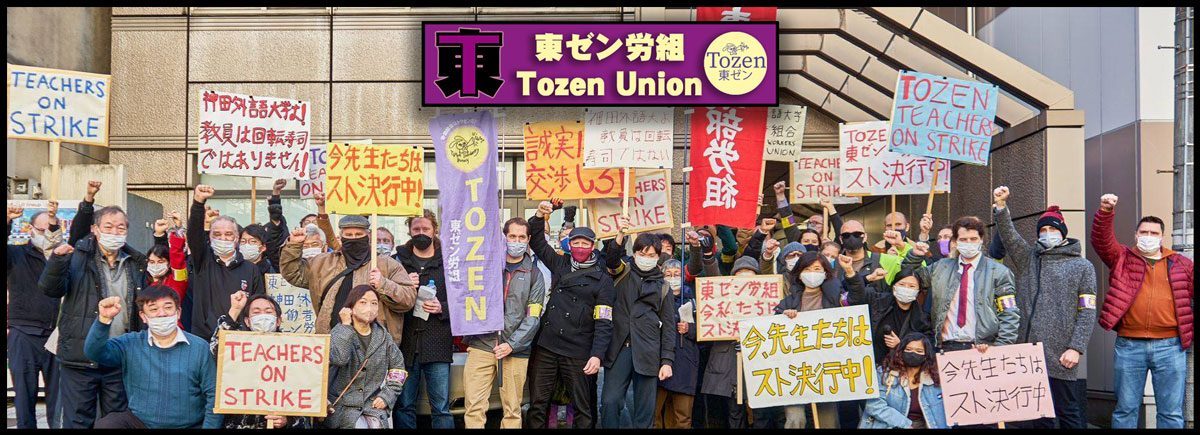
First up, the labor unions (i.e. the ones that let non-Japanese join, even help run). Their annual marches in March, for example, have made it clear to the media (and employers like Nova) that non-Japanese (NJ) workers are living in and working for Japan and that they are ready to stand up for themselves, in both collective bargaining and public demonstrations.

These groups have gained the ear of the media and national Diet members, pointing out the legal ambiguity of trainee visas, and systematic abuses of imported labor such as virtual slavery and even child labor. For example, Lower House member (and former prime ministerial candidate) Taro Kono in 2006 called the entire work visa regime “a swindle,” and opened ministerial debate on revising it.

In the same vein, local NGOs are helping NJ workers learn the language and find their way around Japan’s social safety net. Local governments with high NJ populations have begun multilingual services; Shizuoka Prefecture even abolished their practice of denying “kokumin hoken” health insurance to non-Japanese (on the grounds that NJ weren’t “kokumin,” or citizens).

These governments are holding regular meetings, issuing formal petitions (such as both the Hamamatsu and Yokkaichi “sengen”) to the national government, recommending they improve NJ education, social insurance, and registration procedures.

Still more NGOs and concerned citizens are petitioning the United Nations. Special Rapporteur Doudou Diene has thrice visited Japan on their invitation, reporting that racial discrimination here is “deep and profound” and demanding Japan pass laws against it.

Although the government largely ignored Diene’s reports, United Nations representatives did not. The Human Rights Council frequently referenced them when questioning Japan’s commitment to human rights last May. That’s how big these issues can get.

http://search.japantimes.co.jp/cgi-bin/fl20080603ad.html