The Economy, Trade and Industry Ministry said Wednesday it ordered Nova Corp., the nation’s largest English language school chain, to suspend for six months its recruitment of customers for new contracts of more than one year or 70 lesson hours, starting Thursday.
According to sources, the ministry has concluded Nova’s practice of telling prospective customers they can reserve classes at any time they choose, even though classes at certain times on some days are difficult to book, constitutes giving a “false account” of the company’s services and violates the Specified Commercial Transaction Law.
The Osaka-based company, which gained popularity with its “ekimae ryugaku” model of opening schools near stations, became the first English language school operator to receive a ministry order to suspend business operations.
In recent years, consumer affairs centers have been swamped with complaints of Nova’s practices with some claiming, for example, the company uses an accounting method disadvantageous to customers who cancel their contracts halfway through.
The ministry and the Tokyo metropolitan government launched an investigation into Nova in February, including inspecting the Osaka headquarters, its main Tokyo office and branches in Kanagawa Prefecture.
Under the ministry’s administrative sanction, Nova will be barred from carrying out a number of actions, including soliciting prospective customers for contracts of more than one year, for six months from today, the sources said. But those who already have signed such long-term contracts can continue attending classes. The sanction does not apply to short-term contracts, they added.
“We take the ministry’s decision seriously and offer sincere apology to the people concerned,” Nova President Nozomu Sahashi said at a press conference held in Osaka on Wednesday afternoon.
“We’ll do our best to take care of students and provide them with lessons without any problems,” he added.
Nova introduced a discount system in which students can take classes based on the number of points they purchased. The more points they buy at once, the bigger the discount. To take advantage of this system, many customers signed contracts with points valid for three years.
However, some customers reportedly ended up cancelling their contracts midway through, complaining it was difficult to make reservations and that they could not use up their points before they expired.
Industry sources said foreign language schools usually set contract periods of less than one year to avoid trouble over midterm cancellations.
As of September, Nova operated 926 branches and had about 450,000 students nationwide. Average sales per Nova branch reached 85.68 million yen in fiscal 2005, about 4.9 times higher than the average for its rivals.
Month: June 2007
Nova handed suspension order over tuition fee practices
The Ministry of Economy, Trade and Industry on Wednesday ordered major English-language school operator Nova Corp. to suspend part of its business operations for holding back money from students who cancelled their contracts, ministry officials said.
The ministry issued an order prohibiting Nova from soliciting customers or accepting applications for contracts exceeding one year or new contracts exceeding 70 hours. The suspension will be in place for six months.
It is the first time for the ministry to issue a business suspension order to an English language school under Japan’s special transaction law. People who are currently taking lessons at the language school will not be affected by the order.
Ministry officials explained Nova operates a system in which students buy points enabling them to take lessons. When they buy a large number of points in advance, they can take lessons at a cheaper price.
However, when people cancelled their contracts before finishing their courses, the company lowered the amount of lesson fees it returned to them. In addition the company didn’t inform people about the procedures for canceling contracts.
In April this year, the Supreme Court ruled that Nova’s policy of demanding penalties when students cancelled their contracts violated a law regulating commercial practices. It said the policy restricted students’ right to initiate the cancellation of their contracts, and ruled the practice invalid.
It has also emerged that the company prevented students from canceling their contracts under Japan’s “cooling off” law which states that people can cancel contracts without any obligation if they do so within eight days of forming the contract, by listing students’ contract day as the day they took tours of classes or received explanations about lessons.
Furthermore, when inviting students to take lessons, the company advertised that they could book lessons any time they wanted, but because of the difficulty in securing teachers, it remained difficult to make bookings. Because of this, the ministry reportedly decided to issue a business improvement order to the firm.
The Ministry of Economy, Trade and Industry and the Tokyo Metropolitan Government conducted an inspection of Nova in February in connection with the law regulating commercial practices. It found that several practices that violated the law had been ordered by the company’s general headquarters. The ministry said it judged the company’s practices to be “organized and malicious.”
Nova operates over 900 schools across Japan, and has about 480,000 students. Since 1996, the National Consumer Affairs Center of Japan has received over 7,000 complaints and inquiries about the company.
http://mdn.mainichi-msn.co.jp/national/news/20070613p2a00m0na015000c.html
Competing foreign-worker plans face off
Justice chief’s proposal to open doors, briefly, for all sectors causes stir
“Putting a three-year limit on a foreign worker’s stay in Japan does not give the company doing the hiring any incentive to take the time to train them for specialized work. Of course, there is also the question of how many skilled workers would want to come to Japan if they are forced to leave after three years,” [Hidenori] Sakanaka [director of the NGO Japan Immigration Policy Institute and former head of the Tokyo Immigration Bureau] said.
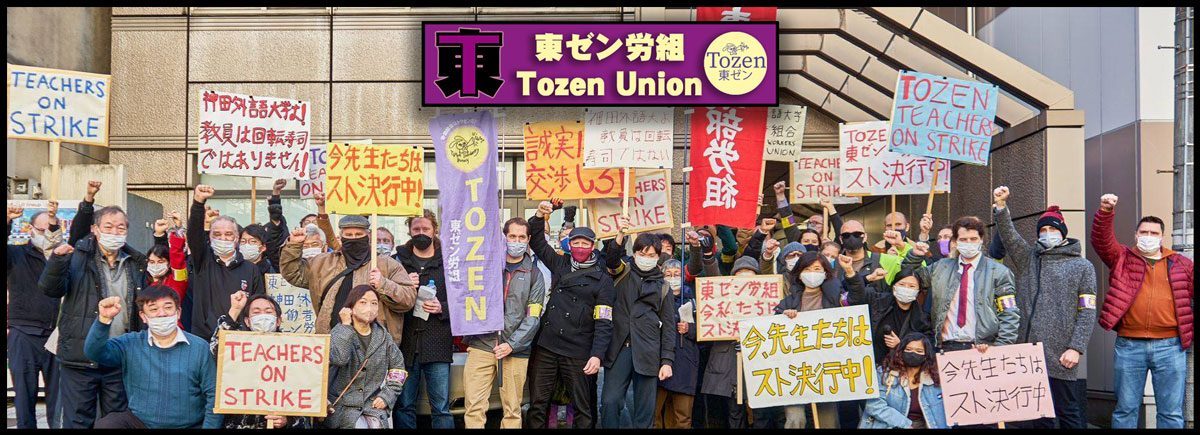
Nambu teams with Zentoitsu to take on Sunrise and Yanagawa-Kogyo
A delegation of six Nambu members joined approximately 50 Zentoitsu union members at a series of demos in eastern Tokyo this morning.
First stop was Sunrise, a small company that manufactures helmets, using trainees from China as a source of labour. The trainee/internship system has been in the news a lot
recently, due to abuses by companies who, instead of training the interns, force them to work long hours for less than minimum wage, with none of the benefits guaranteed to employees under Labour Standards Law. In this case, five Chinese women who made a claim for unpaid wages were forcibly taken to Narita and put on a plane to China. Those who resisted were beaten. Today, union activists expressed their outrage to the owner of Sunrise, who found himself surrounded by angry protestors on the doorstep of his office, in full view of all the neighbours. The demonstration was very loud and tense, but very well-organized. The police at the nearby koban observed from a safe distance, clearly not wishing to get involved in that.
From there, we moved by hired bus (more excellent organization) to Adachi-ku, where we demonstrated in front of Yanagawa-Kogyo, a company which, among other things,
rents construction cranes, one of which was parked in the front lot. Protestors made their way around the construction material to the verandah of the home office, and chanted slogans through the open door, where the owner stood watching. This company dismissed a union member who had insisted on taking his legally-owed number of paid vacation days to deal with back pain brought on by the working conditions.
Coming out to these demos is a great way to build solidarity with our sister union Zentoitsu, and to learn about the conditions faced by other workers in Japan. Watch this space for information about future action.