The number of visas for entertainers issued by Japan is estimated to have fallen by more than 70% from a peak of 140,000 in 2004 to 40,000 this year on tougher visa requirements, according to data made available by the Foreign Ministry on Thursday. The government issues such visas to singers, dancers and other foreign artists willing to work in Japan.
The tougher requirements include a minimum of two years’ experience as an artist, and certification of personal identity and special education records during visa issuance procedures. The number of entertainer visas is expected to decline for Filipinos from 85,000 to less than 10,000 this year, for Chinese from 8,500 to less than 5,000 and for Russians from 6,000 to 3,000, according to the ministry’s data.
Month: December 2006
Author dismisses government’s fear mongering myth of crime wave by foreigners
For years, people like Tokyo Gov. Shintaro Ishihara have been up in arms about rising crime rates among foreigners and juveniles in Japan, but one of the Tokyo Metropolitan Government’s public safety experts has come out to say the claims are groundless, according to Sunday Mainichi (12/31).
Ishihara and his ilk have long laid the blame on foreigners for a perceived worsening of public safety standards that has allowed the powers that be to strengthen and crack down on non-Japanese and teens.
But Hiroshi Kubo, the former head of the Tokyo Metropolitan Government’s Emergency Public Safety Task Force, says they’ve got it all wrong.
“Put simply, the Tokyo Metropolitan Government’s public safety policy involves telling people that public safety standards have worsened and police groups need strengthening to protect the capital’s residents,” Kubo tells Sunday Mainichi. “But I’ve realized there’s something unnatural about this ‘worsening.'”
http://mdn.mainichi-msn.co.jp/waiwai/news/20061221p2g00m0dm003000c.html
Whistle-blowing systems feeble at the local level
Only 20 percent of the 47 prefectural governments and 15 major cities across Japan have third-party points to accept calls from whistle-blowers, an Asahi Shimbun survey showed.
Many other local governments have contact points concurrently managed by local government officials in charge of general affairs. But these contact points are rarely used, meaning that the system to prevent corruption in politics is not functioning properly, the survey found.
The whistle-blower protection law took effect in April this year, banning company and government officials from taking punitive action, such as dismissals, against employees who report illicit activities.
But fears of repercussions abound, particularly in governments that control the whistle-blower system.
“If one is to report wrongdoing under his or her own name, the name will be inevitably leaked and will be identified in the prefectural government,” said an official who once worked in the secretarial section of the Wakayama prefectural government, the site of a recent bid-rigging scandal that forced the governor to resign.
The official said if calls are made anonymously, they will simply be filed as “rumors.”
“We can’t do anything about it unless there is a third-party entity,” the official said.
Two prefectures, including Fukushima Prefecture, where a former governor was recently arrested over another bid-rigging scandal, and one city have no whistle-blowing systems whatsoever, the survey showed.
http://www.asahi.com/english/Herald-asahi/TKY200612230134.html
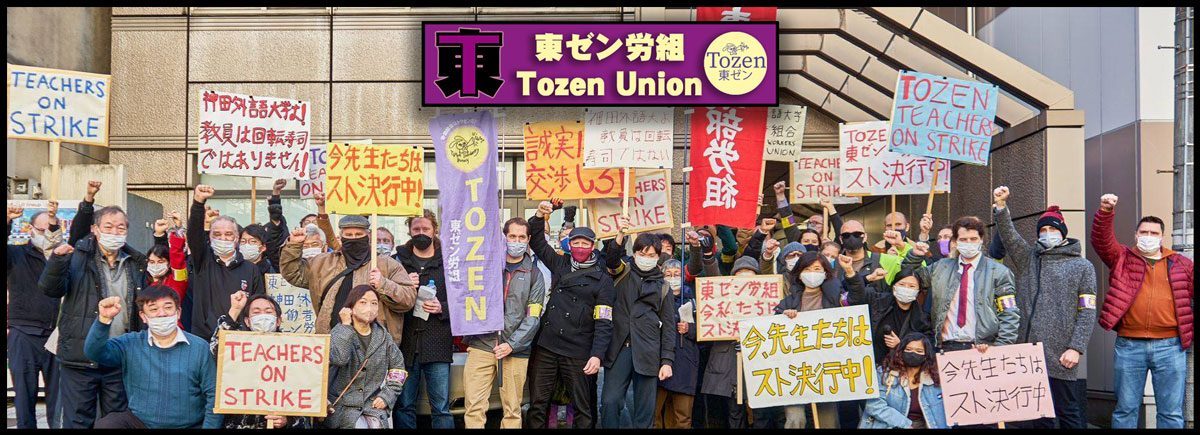
Nambu neunzehn, Nova null
Twenty union members gathered in front of NOVA Ikebukuro school on Sunday to show support for striking teachers at the company. Strikers included a majority of the German department in Ikebukuro, effectively shutting down lessons for the afternoon.
NOVA’s ekimae location was a perfect spot to get our message out to the public, and hundreds of passers-by took leaflets, or stopped to read the signs held by picketers.
The union is demanding job security, and the reinstatement of members who were “non-renewed” after as many as 13 years with the company.
A mobile, disposable work force
Indications of deteriorating working conditions are coming to light at workplaces across the nation as the result of a practice that has become a social issue: More and more manufacturing companies are bringing in contract workers (ukeoi) to have them work like temporary workers (haken) — as if dispatched from staffing agencies — but without haken benefits.
For laymen, the legal difference between these two types of workers is a bit hard to understand.
But the practice not only is illegal and responsible for low wages — usually about half or less of regular-employee wages — but also leads to worker instability. Companies should quit the habit, and the labor standards inspection offices should crack down on violators.
Japan ranks 79th in global report on gender gap
Japan ranked 79th in a global report measuring women’s achievements in key areas, the Swiss-based World Economic Forum said Tuesday. Nordic countries topped the list, with Sweden considered to be a country with the smallest gender gap. Sweden was followed by Norway, Finland and Iceland. The rest of the top 10 countries were Germany, the Philippines, New Zealand, Denmark, Britain and Ireland.
The report measured the extent to which women in the polled countries and regions have achieved equality with men in four areas ? economic participation and opportunity, education attainment, political empowerment, and health and survival. Japan placed first in health and survival along with 34 other nations with the same level of well-being index, but was 83rd in both economic opportunity and political empowerment, bringing the overall ranking to 79th.
Factory denies Muslim basic human rights
A sewing factory in eastern Japan required an Indonesian Muslim trainee to sign a note promising to forgo praying five times a day and Ramadan fasting as a condition of her employment, The Yomiuri Shimbun learned Monday.
The firm also prohibited her from owning a cell phone and exchanging letters.
The Justice Ministry suspect the firm’s practice infringes on the woman’s human rights in violation of its guidelines for accepting trainees, which is based on the Immigration Control and Refugee Recognition Law, and the International Covenant on Civil and Political Rights.
According to the note written both in Japanese and Indonesian, the factory prohibited the woman from worshipping on the firm’s property and fasting while in Japan.
She was also prohibited from exchanging letters domestically, sending money to her family or traveling in vehicles.
In addition, she had a curfew of 9 p.m. at her dormitory and was not allowed to invite friends there.